
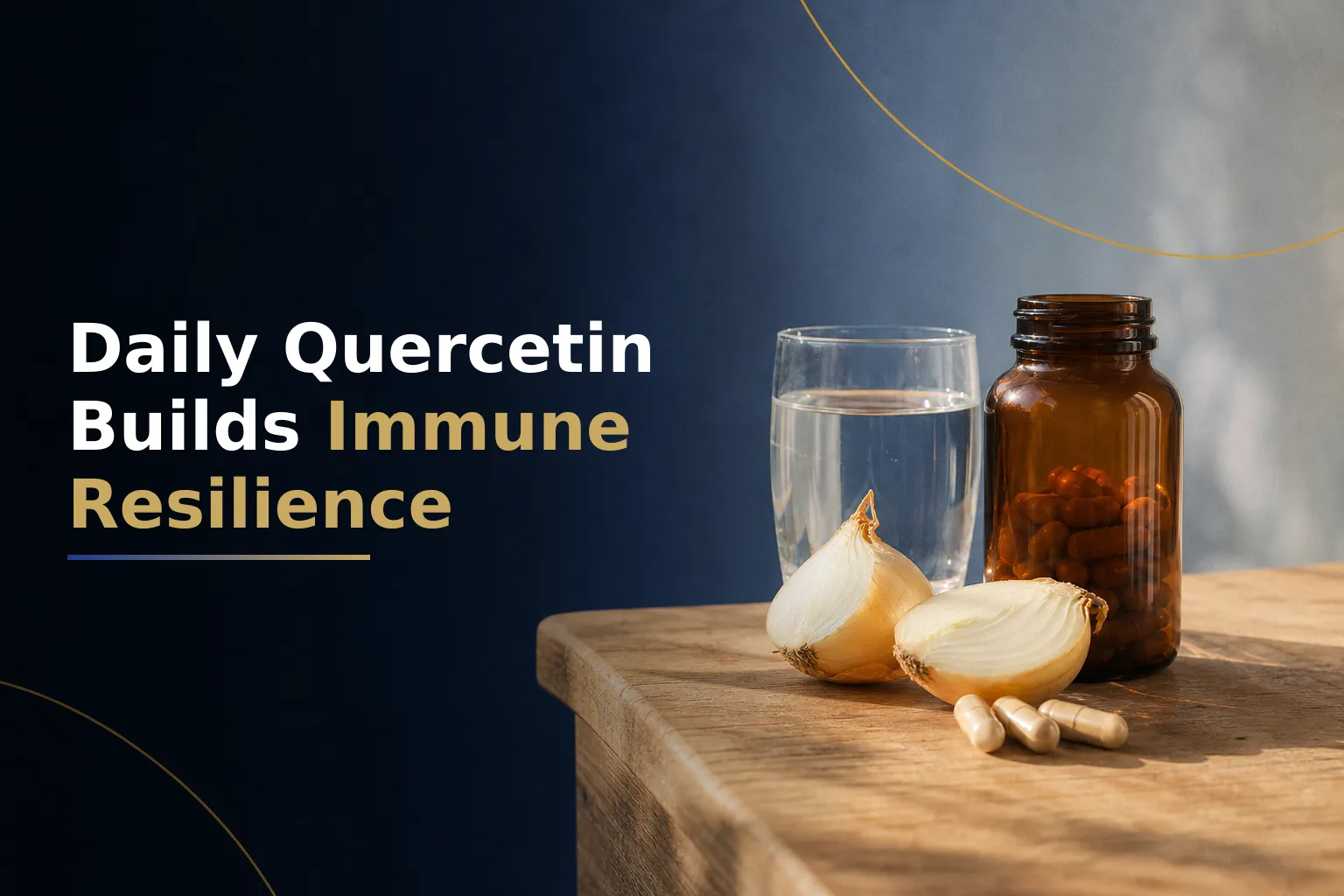
Most people treat quercetin like an umbrella - something to grab only when it rains. A sore throat starts, a season changes, a bottle appears on the counter. That makes sense, but it doesn't match how quercetin works in your body. To support immune function, you need steady quercetin levels from daily doses, not one big dose when you get sick.
The Half-Life Problem With Reactive Loading
Quercetin is a flavonoid with a half-life of about 3.5 hours after you take it by mouth, according to a study in The Journal of Nutrition (Hollman et al., 2000). How much your body absorbs from one dose varies - usually between 3 and 17 percent in healthy adults, depending on the type of quercetin, whether you ate fat with it, and your gut bacteria.
What this means if you try to load up after getting sick is straightforward: a large dose causes a spike in quercetin that drops back down within hours. Any immune benefit that needs steady quercetin levels can't happen in that short window.
What Repeated Daily Dosing Does to Blood Levels
A 2008 study in The Journal of Nutrition had healthy adults take increasing doses of quercetin for two weeks. Researchers found dose-dependent increases in blood quercetin levels across all groups, with the highest dose raising levels 570 percent higher than people on placebo (McAnulty et al., 2008). The reason is straightforward: quercetin's short half-life means it clears before your next dose, but when you take it consistently, your blood levels build up through the day and keep building across weeks.
A different study on multiple quercetin formulations in healthy adults looked at total exposure to quercetin and found it increased with repeated doses. But there's big variation between people - blood quercetin levels differed by 36 to 57 percent between participants (Ramos-Romero et al., 2023). That variation is why consistency matters - you won't know how your body responds until you stick with it for weeks.
What the Immune Trials Actually Showed
The biggest study on quercetin and immune health enrolled 1,002 adults aged 18 to 85, split into three groups: 500 mg daily, 1,000 mg daily, or placebo, for 12 weeks. Participants logged respiratory infection symptoms every day using a standard survey (Nieman et al., 2010). The overall result: quercetin didn't reduce respiratory infections or symptoms compared to placebo across all participants.
But here's where most people stop reading. Among adults aged 40 and older who said they were in the top half for fitness - a group with solid immune health to protect and likely higher physical demands - the 1,000 mg group had 36 percent fewer severe infections and 31 percent fewer sick days than placebo (p=0.020 and p=0.048). The 500 mg dose didn't produce significant results in this same group.
Twelve weeks of daily dosing produced that result - not just one week of loading once you get sick. For more on this approach to immune support, see the article on preventive versus reactive dosing with herbs.
The Mechanism - Why Pre-Loading Matters
One of the key studied mechanisms behind quercetin and immune function involves mast cell regulation. A study in European Journal of Pharmacology found that quercetin reduced the expression and release of TNF-alpha, IL-1beta, IL-6, and IL-8 from human mast cells by lowering NF-kappaB and p38 MAPK signaling (Moon et al., 2007). Reducing these inflammatory signaling pathways is an ongoing effect, not something that happens all at once.
Quercetin doesn't arrive and immediately shut down active inflammation the way some drugs do. Instead, it seems to raise the threshold where mast cells react to triggers. Raising that threshold requires consistent exposure - which is why building the daily habit before a stressful period works better than loading once symptoms show up.
Building the Daily Habit
The practical approach is simple. Take quercetin with a meal that contains some fat. Quercetin's fat-soluble nature means your small intestine absorbs it better when eaten with fat - something that works more efficiently after a meal than on an empty stomach. Morning, with breakfast, is a reliable daily trigger and helps you avoid mid-afternoon forgetting that ruins most supplement routines.
The dose that produced measurable immune effects in the Nieman trial was 1,000 mg per day. Whether you can get that from food alone is worth noting: quercetin is in capers, raw onions, apples, and berries, but in amounts that make 1,000 mg from food unrealistic. The article on quercetin bioavailability in food versus supplements shows the gap clearly.
Quercetin Daily 1.0 G provides the 1,000 mg daily dose that matched the studied approach in the Nieman trial. Taken consistently with a meal containing fat, started several weeks before a period of stress - seasonal shifts, dense travel, or hard training blocks - it follows the dosing approach the research supports. If you already take curcumin daily, the two have different anti-inflammatory pathways with little overlap. The article on why curcumin pairs with quercetin covers that detail, and the same logic applies to immune and general antioxidant support.
Who Should Talk to a Doctor First
Most people tolerate 1,000 mg daily of quercetin well in short-term studies. But quercetin inhibits cytochrome P450 enzymes - including CYP3A4 and CYP2C9 - which break down many common prescription drugs. This matters if you take immunosuppressants, blood thinners, cyclosporine, or certain heart medications. Those drugs could build up in your body. If you take any of these medications, talk to your doctor before starting quercetin.
If you're pregnant or breastfeeding, safety data at supplement doses is limited. Food quercetin is a different level of exposure, but 1,000 mg from a supplement is much more than the quercetin in a serving of onions. Talk to your doctor before starting at that dose.
For more on seasonal immune support and how quercetin fits into a broader approach, see the Immunity and Wellness collection. If you're ready to take quercetin consistently at the dose the research points to, Quercetin Daily 1.0 G is designed for exactly that.
Vuoi altri contenuti come questo? Unisciti all'Inner Circle e ricevi un articolo curato ogni domenica.