
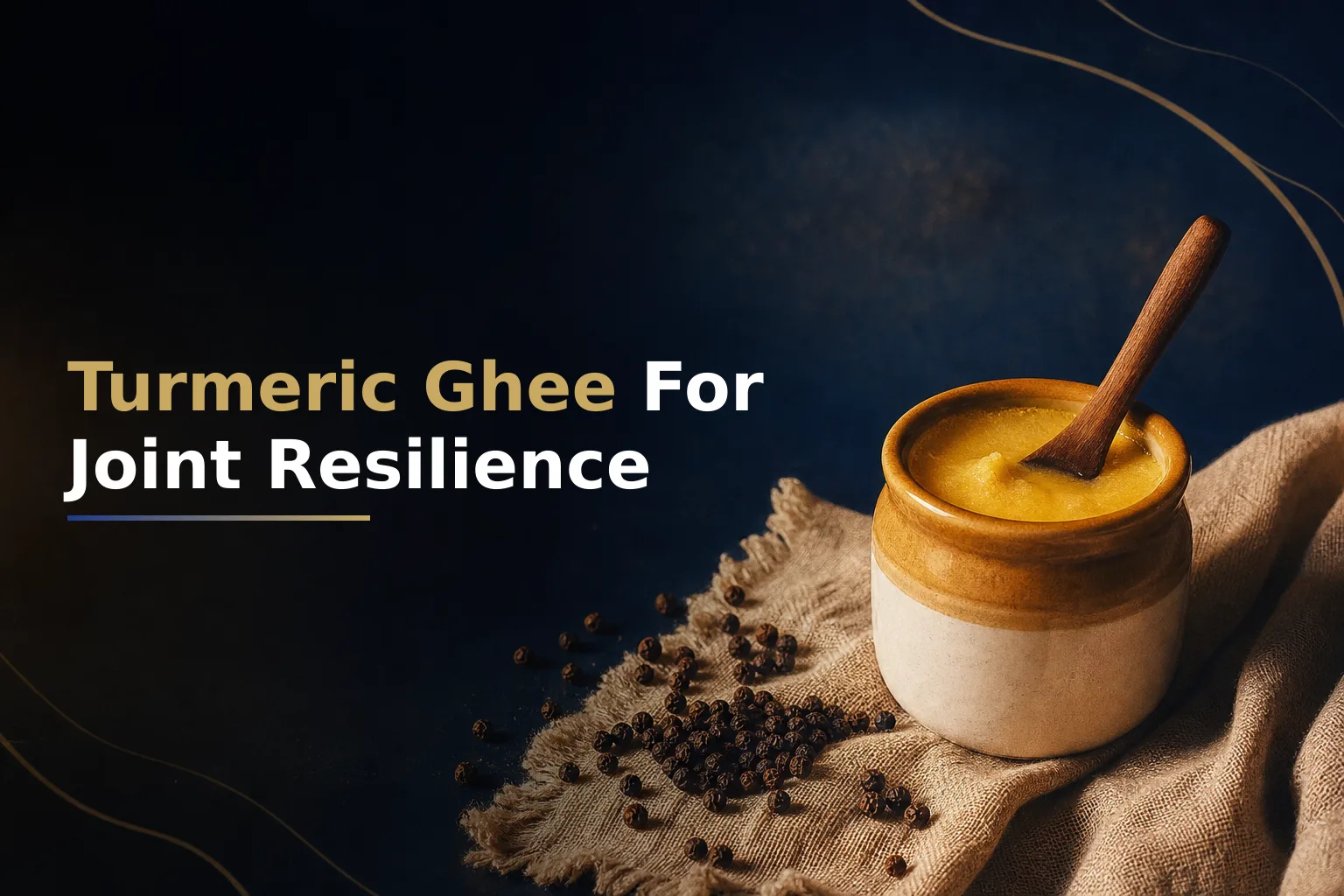
Most turmeric ends up stirred into hot water or sprinkled dry over food. You get the color and taste, but the curcumin - the compound that most research focuses on - mostly passes through your body unabsorbed. This is not a quality issue with the spice. It's a chemistry problem with how you prepare it. Three things improve how well your body absorbs it: fat, something to slow liver processing, and gentle heat. This recipe uses all three.
Why Fat Comes First
Curcumin dissolves in fat, not water. Its structure actively repels water and seeks fat. That matters because it gives curcumin activity in cell membranes, but it also means curcumin needs fat to travel from your gut to your bloodstream. In water, curcumin clumps and passes through mostly unabsorbed. In fat, your lymphatic system can pick it up and move it into your blood.
A study of curcumin formulations found that a fat-based version at 750 mg produced much higher blood levels than plain powdered curcumin at the same dose. This shows that fat is not optional - it's necessary. (Bioavailability of a Lipidic Formulation of Curcumin in Healthy Human Volunteers, Food and Chemical Toxicology)
Ghee is a smart choice for two reasons. It's clarified butter with almost no water, so the turmeric spreads evenly without clumping or separating as it cools. Its flavor is mild enough to let the spice come through, and it keeps at room temperature for months without refrigeration - better than butter or most liquid oils for this job.
The Role of Black Pepper
Piperine gives black pepper its heat, and it blocks an enzyme process called glucuronidation - how your liver breaks down and clears compounds, including curcumin, before they can circulate. The result is that curcumin stays in your bloodstream much longer.
A key study by Shoba and colleagues in 1998 tested this. They gave 2 g of curcumin to healthy people with or without 20 mg of piperine - about the same as 2 g of whole black pepper, or roughly one-third of a teaspoon freshly ground. The group with piperine had 2000% higher curcumin levels in their blood compared to curcumin alone, measured in a single-dose test. (Shoba G. et al., Influence of piperine on the pharmacokinetics of curcumin in animals and human volunteers, Planta Medica, 1998)
That number shows up in ads so much it's become noise. What it really describes is one blood-level measurement in a single-dose test - not what happens over time. The finding is real. The half-teaspoon of black pepper in this recipe does something measurable at the level of how your liver handles curcumin. It does not multiply health outcomes by that amount.
What the Joint Research Shows
Curcumin affects inflammatory pathways in lab and animal studies - including ones called NF-kB and COX-2. These pathways matter for joint swelling, which is why joint health is one area scientists study curcumin for in human trials. The evidence is modest but real.
A randomized, double-blind, placebo-controlled study in Phytotherapy Research gave people with knee osteoarthritis either 1500 mg of curcuminoids per day - 500 mg three times a day - or a placebo for six weeks. The curcuminoid group had lower pain scores and better movement compared to placebo. (Panahi Y. et al., Curcuminoid treatment for knee osteoarthritis: a randomized double-blind placebo-controlled trial, Phytotherapy Research, 2014)
A 2023 review of curcumin and piperine together across clinical studies found they consistently lowered inflammatory markers. The authors noted big differences in how much people took across the studies and called for larger, more controlled research before drawing firm conclusions. (Rahmani S. et al., Curcumin-piperine co-supplementation and human health: a comprehensive review, Phytotherapy Research, 2023)
A 2025 study tested turmeric alone versus turmeric with black pepper on pain in adults over 40. The combination was linked to more pain reduction than turmeric alone over 21 days. (Gillette P. et al., Bioenhancer Assessment of Black Pepper with Turmeric on Self-Reported Pain Ratings in Adults, Nutrients, 2025)
These are supplement-level doses in studies. What a food recipe realistically does is covered in the last section.
Turmeric Ghee with Black Pepper
This makes about one cup - sixteen tablespoons - of prepared ghee. It keeps at room temperature for up to three months in a sealed jar, or longer if refrigerated. Use it as a finishing fat over cooked dishes, stir it into warm milk, or take a small spoonful with a meal rather than alone.
Ingredients
- 1 cup (225 g) unsalted ghee
- 3 tablespoons (18 g) ground turmeric powder
- 1/2 teaspoon (1.5 g) freshly ground black pepper
- 1/4 teaspoon ground dry ginger (optional)
Method
- Warm the ghee in a small saucepan over the lowest heat setting until just melted and liquid. It should not smoke or sizzle.
- Remove from heat. Add the turmeric and black pepper - and ginger, if using. Stir for two to three minutes until fully combined. The color will be a deep orange-gold with no dry pockets of spice.
- Pour into a clean, dry glass jar. Let it cool at room temperature, uncovered, until solid.
- Seal and store. Label with the date you made it.
Using It Daily
One to two tablespoons stirred into a cup of warm - not boiling - whole milk makes a simple morning or evening drink. The fat in the milk acts as a second fat carrier alongside the ghee. You can add a small pinch of freshly ground black pepper directly to the cup to add more piperine to what's already in the ghee.
It also works as a cooking fat for eggs, as a finishing drizzle over lentils or roasted root vegetables, or spread thinly on bread with a meal. The preparation fits into regular cooking without requiring a separate routine. Warming the ghee briefly before adding it to cold dishes helps it spread more evenly through the food.
One tablespoon of this ghee contains about 1.1 g of ground turmeric. Curcuminoid content in kitchen turmeric powder varies by type and how it's processed - and even with fat and piperine helping absorption, a food recipe does not come close to the 1500 mg per day of standardized curcuminoid extract used in the joint studies mentioned above.
A Note on Dose
This recipe is not a substitute for a standardized curcumin supplement if your doctor has recommended one. What it is: a regular cooking habit that meaningfully improves how much curcumin from food your body absorbs, done over time.
If you're thinking about how absorption affects other joint-health nutrients, the piece on why absorption matters for collagen supplements covers the same logic for a different nutrient and is worth reading with this one.
If you take prescription medications, are pregnant, or are breastfeeding, talk to your doctor before making turmeric a regular habit beyond normal cooking - high amounts of curcumin may interact with blood thinners and can affect your liver.
To see what we carry for this area, visit the Joint and Bone collection.
¿Quieres más artículos como este? Únete al Círculo Íntimo y recibe una pieza cuidada cada domingo.