
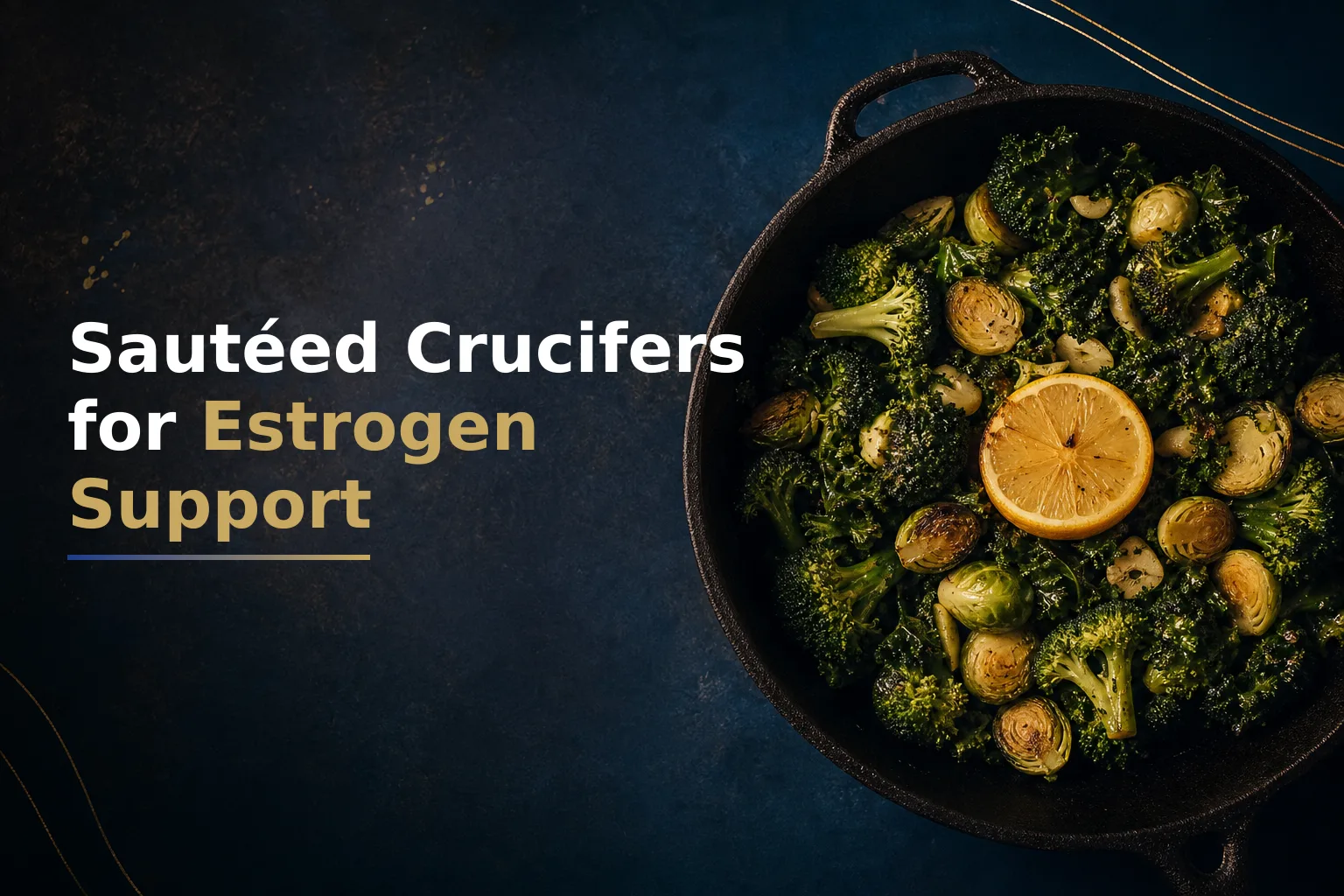
Cruciferous vegetables get more attention in nutrition now. That makes sense - broccoli, kale, and Brussels sprouts contain sulfur compounds that researchers have studied for their effects on estrogen metabolism. How you cook these vegetables matters for whether you get those benefits.
This recipe shows you how. It uses a quick sauté, which keeps more of the active compounds than boiling does. It also uses dry mustard to bring back some enzyme activity that heat destroys. You should know the science behind these choices.
The Biochemistry, in Plain Terms
When you chop or chew a cruciferous vegetable, you break cell walls and release myrosinase - an enzyme that breaks down glucosinolates into a group of compounds including indole-3-carbinol (I3C). I3C then passes into your stomach's acidic environment, where it becomes 3,3'-diindolylmethane, or DIM.
Researchers have studied DIM because it may shift estrogen metabolism toward the 2-hydroxylation pathway - a route that produces forms of estrogen that are less active in the body than those from the 16-alpha-hydroxylation route. A 1991 study in Nutrition and Cancer found that oral I3C increased estradiol 2-hydroxylation by about 50 percent in 12 healthy volunteers. (Michnovicz et al., Nutr Cancer, 1991) Whether this shift matters for healthy women eating regular food is still unclear, but researchers have well described how it happens.
Why Cooking Method Is Not a Small Detail
Myrosinase denatures above roughly 80 degrees Celsius - right at boiling temperature. When you boil cruciferous vegetables, the enzyme breaks down before it can work. The water-soluble glucosinolates leak into the cooking liquid that most people throw away. You lose both the enzyme and the compounds.
Sautéing - quick cooking with high heat and no water - solves both problems. A 2019 study in Foods compared cooking methods for several cruciferous vegetables and found that stir-frying kept more total glucosinolates in kale than boiling did. (PMC6679111, Foods, 2019)
Sautéing does lose some myrosinase, but there's a fix: add a raw brassica source. Dry mustard powder contains active myrosinase that hasn't been heated. Researchers have found that adding myrosinase to cooked cruciferous vegetables can bring back some of the conversion of glucosinolates to their active forms. (PMC4985713, Front Plant Sci, 2016) That's why this recipe adds mustard powder off the heat.
For a closer look at how preparation method affects DIM uptake specifically, see our earlier piece on Raw or Roasted Cruciferous Vegetables and DIM Uptake.
The Recipe: Garlic-Sautéed Crucifers with Mustard and Lemon
Serves two. Takes less than 15 minutes from pan to plate. This recipe uses a quick sauté with high heat and no water - the key to keeping active compounds. It adds dry mustard powder off the heat to supply raw myrosinase. You can serve a handful of uncooked watercress or arugula alongside for even more active enzyme.
Ingredients
- 180 g broccoli florets, cut small
- 150 g Brussels sprouts, halved and sliced thin
- 80 g curly kale, stems removed, leaves torn
- 3 cloves garlic, sliced thin
- 2 tablespoons extra-virgin olive oil
- Juice of half a lemon
- Half a teaspoon dry mustard powder, added off-heat
- Flaky sea salt and cracked black pepper
- Optional: a small handful of raw watercress or arugula to serve alongside
Method
- Heat a wide, heavy-bottomed skillet over medium-high heat. Add the olive oil and let it warm for about one minute.
- Add the Brussels sprouts cut-side down in a single layer. Leave them undisturbed for two to three minutes until they develop color. Turn and cook for one further minute.
- Add the broccoli and garlic. Stir to coat and cook for three to four minutes, moving the pan occasionally. The broccoli should be bright green and just tender - not soft.
- Add the kale and cook for one further minute until just wilted. Remove the pan from heat immediately.
- Squeeze the lemon over the vegetables, then sprinkle the mustard powder evenly across the pan and toss to combine. The residual warmth activates the mustard without destroying its myrosinase.
- Season with salt and pepper. Transfer to plates. If using the watercress or arugula, arrange it alongside - not into the hot pan.
A Note on Timing
Eat these vegetables soon after cooking. Glucosinolate conversion continues briefly at warm temperatures, but the window closes quickly. If you cook ahead, undercook slightly and reheat gently once - reheating multiple times destroys enzymes just like overcooking does.
What Whole-Food Amounts Can and Cannot Do
How much DIM your body makes from cruciferous vegetables depends on how much you eat, how well you chew, your stomach acid, and your gut bacteria - which differ between people and even change in the same person over time. Food doesn't deliver consistent amounts of any compound.
A 2004 pilot study gave 108 mg of DIM daily to postmenopausal women for 30 days and found an increase in urinary 2-hydroxy estrogen metabolites. (Dalessandri et al., Nutr Cancer, 2004) To get that much DIM from food, you'd need to eat several hundred grams of raw or barely cooked cruciferous vegetables every day. A well-prepared sauté is better than boiled vegetables, but you still won't reach the doses used in studies with food alone.
A study of DIM's effect on premenopausal women found measurable shifts in estrogen metabolite ratios when they took supplements. The authors noted that larger trials are needed to determine whether these shifts matter for healthy women. (PMC11583660, 2024)
For a detailed comparison of how DIM and I3C work as supplements and how dosing compares, see DIM vs. I3C: Dr. Naomi Reade on Cruciferous Dosing.
One Group That Should Read the Label Carefully
Supplements with DIM pose a specific risk for women taking hormone therapy. A 2025 study found that postmenopausal women taking DIM with transdermal estradiol had very different urinary estrogen profiles than those not taking DIM - which suggests the supplement might reduce how much estrogen from the therapy reaches your body. (PMC12188845, 2025) If you take prescription estrogen for menopause, talk to your doctor before adding a DIM or I3C supplement.
This recipe is fine for most adults eating a varied diet. Like other supplements that affect hormones, people taking prescription medication, pregnant people, or those breastfeeding should talk with their doctor before using cruciferous extract supplements.
To see our studied formulations for hormonal health, visit our Hormonal Balance collection.
For a standardized source of DIM and I3C, Ayurnomics's Cruciferex Daily 425 provides both compounds as a cruciferous extract per manufacturer directions - best used with crucifer-rich eating, not as a replacement.
Möchten Sie mehr davon? Treten Sie dem Inner Circle bei und erhalten Sie jeden Sonntag einen sorgfältig kuratierten Beitrag.