
The supplement aisle makes sourcing hard to track. An immune blend label lists its herbal actives in milligrams, and most consumers read those numbers as guarantees. They are not. A milligram figure tells you how much plant material went into the capsule. It says nothing about how much of the active compound that material actually had when it arrived at the facility, or whether the plant was correctly identified before processing began.
These gaps - between an ingredient name and a verified constituent concentration - are where most herbal immune formulas differ, and where meaningful sourcing conversations must start.
What Standardization Actually Means
Standardization is a manufacturing commitment: the producer measures a defined marker compound in each batch and guarantees it falls within a specified concentration range. For herbal actives, this matters more than it does for synthetic ingredients because plants vary. Soil quality, harvest timing, altitude, rainfall, and post-harvest handling all change the concentration of the compounds you are paying for. An unstandardized elderberry powder and a standardized elderberry extract with a declared anthocyanin percentage are not equivalent products, even if both appear on a label under the same Latin name.
A 2023 systematic review and expert analysis of andrographis, echinacea, and related herbal actives in treating acute respiratory tract infections found that variable plant compound levels across extract preparations was a main reason for inconsistent results across trials - even when trials nominally used the same plant species. The authors concluded that differences in extract makeup limited the ability to understand many human studies.
This is why standardization matters: clinical evidence is built on specific preparations at specific concentrations. A product that does not match those preparations cannot reasonably claim the evidence applies to it.
The Problem With Marker Compounds
Standardization is only as meaningful as the marker being measured. A 2016 analysis in Frontiers in Plant Science found a problem: some marker compounds used to standardize herbal supplements do not reliably match the herb's activity. A supplement can test high on its declared marker and still deliver little or no real effect, depending on which compound was chosen as the standard and how that compound works in the body.
For immune blends, this means two products both marked as standardized may work very differently, depending on whether the chosen marker is an active ingredient that was studied in humans or just a compound that is easy to measure. Knowing which marker a manufacturer uses - and whether that marker appears in human clinical studies - is a better question than knowing the standardization percentage alone.
Andrographis: The Diterpene Lactone Standard
Andrographis paniculata is among the better-studied herbs for acute immune support. Its primary active constituent is andrographolide, a diterpene lactone. A 30-day open-label study in 30 healthy adults, using 200 mg of standardized Andrographis paniculata extract daily, found measurable changes in NK cell counts and serum cytokine patterns compared to baseline. The study authors concluded that the extract showed immunomodulatory effects in this preliminary cohort, while noting the limits of an open-label design without a placebo group. Andrographolide percentage is the standardization specification that connects this human data to a commercial product. An andrographis powder without a declared andrographolide level offers no way to know whether it delivers the active ingredient at any meaningful concentration.
Echinacea: Where the Plant Part Matters
Echinacea purpurea presents a sourcing challenge. Different parts of the plant - aerial parts versus root - contain different amounts of alkylamides, polysaccharides, and caffeic acid derivatives. Alkylamides are considered the main immune-active ingredients in alcohol extracts, while polysaccharides are more prominent in water-based preparations. A product standardized to polysaccharides and one standardized to alkylamides are not the same, even when both carry the same Latin name on the label.
A 2023 study published in PMC found that a standardized Echinacea purpurea extract with high chicoric acid content enhanced macrophage activity in mouse models and in a cyclophosphamide-induced immunosuppression model. Human studies remain limited and inconsistent, but the lab data shows the importance of knowing exactly which compounds have been measured and declared. For context on how label transparency in proprietary immune formulas relates to this sourcing question, our earlier examination of what herbal immune blend labels actually tell you covers what a consumer can and cannot reasonably infer from a supplement facts panel alone.
Elderberry: The Anthocyanin Signal
Elderberry (Sambucus nigra) has strong consistent human evidence in the herbal immune category. A 2019 meta-analysis of four randomized controlled trials found that black elderberry reduced upper respiratory symptom scores. The analysis showed large results, though all trials used standardized preparations with defined plant compound content. A separate randomized, double-blind, placebo-controlled trial in 312 air travelers found that a standardized filtered elderberry extract shortened cold duration and reduced symptom severity compared to placebo, with the preparation used specifying a defined anthocyanin content.
The anthocyanin specification is the practical sourcing signal for elderberry. A product with no declared anthocyanin percentage cannot claim the backing of trials that used a standardized extract.
What a Credible Certificate of Analysis Contains
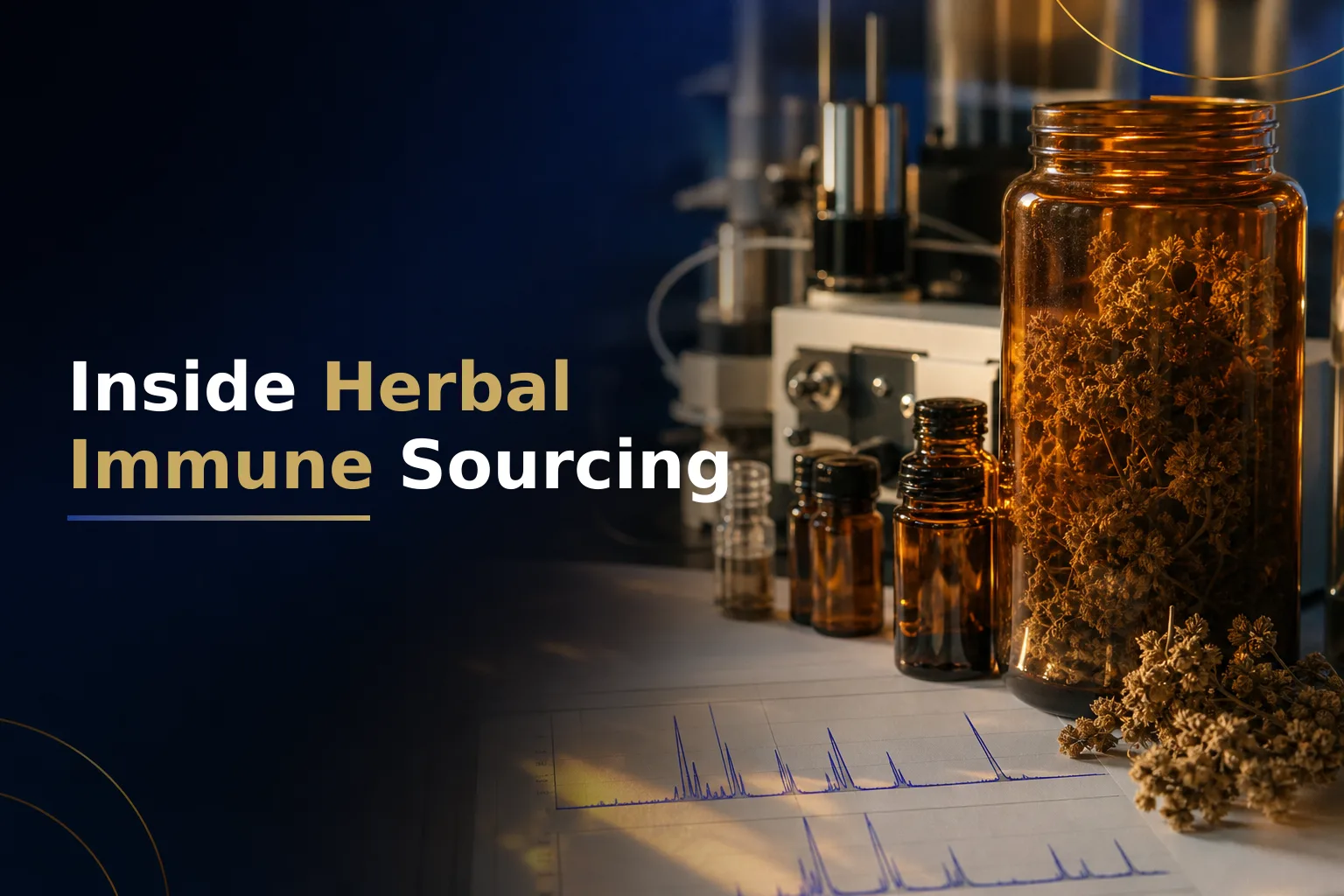
A certificate of analysis (CoA) for a standardized herbal extract should include sensory data, moisture and ash content, HPLC marker compound analysis with specified ranges, heavy metal testing (lead, arsenic, cadmium, mercury), pesticide testing, and microbial testing. A 2007 review on quality assurance for botanical dietary supplements said all plant material should be verified by chromatographic comparison against authenticated reference standards. The authors noted that processing and extraction can degrade morphological identifiers, making chemical fingerprinting better for verifying processed botanical extracts.
Adulteration in the botanical supply chain is a problem. Species substitution and dilution can go undetected when CoA verification is limited to sensory inspection alone. Third-party identity testing - including DNA barcoding for species confirmation where morphological markers are unreliable after extraction - is a higher verification standard, and one worth asking about by name.
Multi-Herb Formulas Multiply the Questions
Each ingredient in a multi-herb immune blend requires its own standardization specification, its own CoA, and its own identity verification. A formula with five botanical actives should be supported by five independent supplier documents, not a single aggregate panel. Sourcing consistency is also a year-to-year question: plant chemistry varies between growing seasons, and supplier audits at regular intervals are an important difference between formulators who only check sourcing once versus those who check it regularly.
The transparency of proprietary blends is a related concern, discussed in our analysis of why proprietary herbal blends are not automatically a quality concern - provided the manufacturer can produce supporting documentation on request. The two questions are connected: a proprietary formula can be transparent, but it does require that the manufacturer has done the standardization and identity verification work, and can explain their process.
If you are taking prescription medications, are pregnant, or are breastfeeding, speak with a clinician before adding any herbal immune supplement to your routine. Herbal actives can interact with certain pharmaceutical compounds, and concentration variability between products makes generalized dosing guidance unreliable across brands.
Ayurnomics's Myeloguard Herbal Immune is formulated as a multi-herb immune complex. Follow the manufacturer's directions. The sourcing and standardization standards behind each active ingredient are the questions worth asking of any formula you consider. For a broader view of evidence-grounded immune support options, explore the Immunity & Wellness collection.
Want more like this? Join the Inner Circle for one considered piece every Sunday.